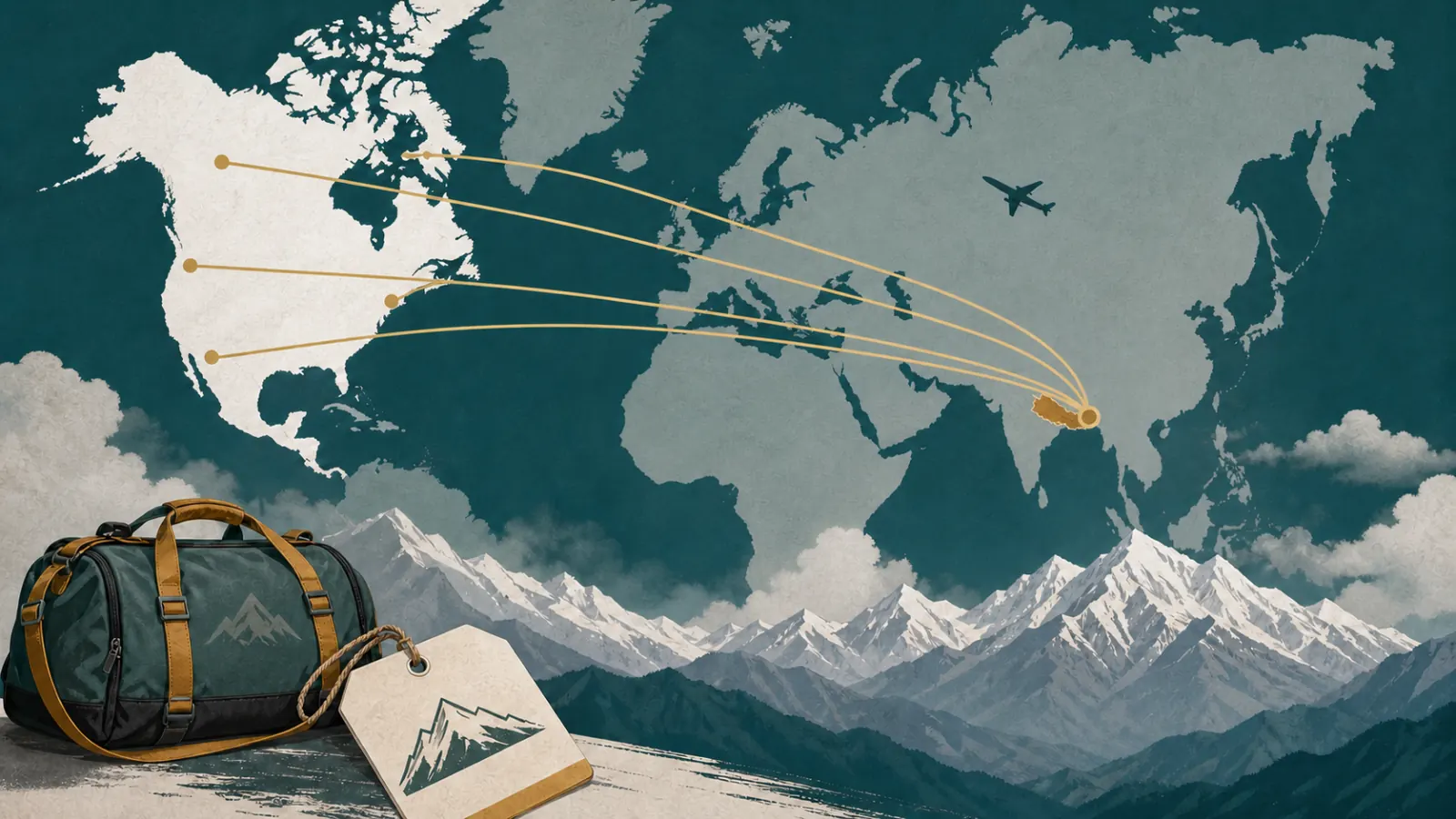
Short answer: There are no nonstop scheduled flights from the United States or Canada to Nepal. Most flights from USA to Nepal—and most itineraries from Canada—reach Tribhuvan International Airport (KTM) in Kathmandu with at least one connection, commonly through Doha, Dubai or Istanbul. The strongest itinerary is usually a single through-ticket with sensible connection time, checked baggage confirmed to Kathmandu and enough flexibility for the start of your trek.
This guide is for travelers comparing routes from North America to Nepal in 2026. Airline networks, baggage allowances and entry rules can change, so use the framework below to compare tickets and verify the final details with the operating airline and the relevant immigration authority before departure.
Start With the Ticket, Not the Airline Ranking
There is no universal “best airline” for Nepal. A good choice from New York may be inconvenient from Vancouver, and the cheapest fare may become poor value if it requires a self-transfer, an overnight airport change or restrictive baggage.
15-Day Everest Base Camp Trek
Guided Himalayan journey to Everest Base Camp (5,364m). Includes permits, teahouse lodging, all trekking meals, local Sherpa guide, porters, and Lukla flights.
Before comparing cabin reviews, check these five points:
- One booking reference: Prefer an itinerary ticketed through to KTM, even when a partner airline operates one leg.
- Protected connections: Confirm what the airline will do if a delay causes you to miss the onward flight.
- Baggage destination: Ask whether checked bags are tagged through to Kathmandu or must be collected during transit.
- Airport and terminal: Check that the connection remains at the same airport and whether immigration clearance is required.
- Fare conditions: Compare change fees, cancellation terms, seat selection and the baggage allowance shown on the actual ticket.
Practical rule: A slightly longer through-ticket is often easier to manage than a shorter itinerary assembled from separate tickets.
Common Flight Routes From the USA and Canada to Nepal
The routes below are common patterns, not guarantees for every city or travel date. Confirm your exact itinerary in the airline’s current booking system.
| Connection pattern | When it can work well | What to verify |
|---|---|---|
| Doha (DOH) Qatar Airways or partner itinerary | Often a practical one-stop pattern from a Qatar-operated North American gateway, or a through-ticket with a feeder flight. | Qatar’s current network, the operating carrier on the feeder leg, baggage through-check and the connection time at Doha. |
| Dubai (DXB) Emirates/flydubai or partner itinerary | Useful when the long-haul and Kathmandu sectors are sold on one ticket through Dubai. | Whether a Canadian or US feeder is partner-operated, whether bags transfer automatically and whether the itinerary requires entry into the UAE. |
| Istanbul (IST) Turkish Airlines itinerary | Can provide a one-stop route when your North American origin connects cleanly with the Istanbul–Kathmandu service. | Current operating days, the minimum connection, terminal details and the baggage allowance on your fare. |
| East Asia Airline or partner itinerary via cities such as Singapore or Hong Kong | May be worth comparing from the West Coast or Vancouver when sold as a protected through-ticket. | Number of stops, self-transfer risk, immigration requirements and whether bags are checked to KTM. |
The Qatar Airways 2026 network schedule lists Kathmandu and its current operated gateways. Its Canadian gateways include Toronto and Montréal, while Vancouver itineraries may require a partner or feeder flight. The Emirates route map likewise identifies its operated network; in Canada it currently lists Toronto and Montréal rather than Vancouver. Turkish Airlines lists Kathmandu in its current destination network.
From the eastern and central United States
One-stop itineraries through Doha, Dubai or Istanbul are often the first comparison. Look beyond the advertised journey time: an itinerary arriving in Kathmandu late at night may leave little margin for delayed baggage, rest or a next-morning trek departure.
From the US West Coast
Compare both Middle East and eastbound Asia routings. The fastest-looking option is not always the simplest if it adds a separate ticket or requires baggage collection during transit. A protected itinerary and a manageable layover usually matter more than saving a small amount of scheduled time.
From Canada
Toronto and Montréal have more airline-operated long-haul gateway options. From Vancouver, Calgary, Edmonton and other cities, examine whether the first segment is a domestic or partner-operated feeder and whether the entire journey remains on one ticket. Do not assume that a city displayed in an airline search result is an airport that airline serves with its own aircraft.
Through-Ticket or Self-Transfer?
A through-ticket places the journey to Kathmandu on one ticket. Airlines can still use partners, but the connection and baggage arrangements are normally defined as one itinerary. A self-transfer uses separate tickets. You may need to enter the transit country, collect bags, change terminals or airports and check in again.
Before accepting a self-transfer, confirm:
- whether your passport permits entry into the transit country;
- whether you must collect and recheck baggage;
- how early the second airline closes check-in;
- whether an airport or terminal transfer is required;
- what happens if the first flight is late; and
- whether your travel insurance covers a missed connection on separate tickets.
Separate tickets are not automatically wrong, but the traveler carries more of the disruption risk. Build a much larger margin—or an overnight stop—when immigration, baggage collection or an airport transfer is involved.
Do You Need a Transit Visa?
Transit requirements depend on your passport, travel document, airport, ticket structure and whether you remain in the international transit area. A US or Canadian passport does not remove the need to check the rules for the exact itinerary.
- Doha: Qatar’s current aeronautical information says passengers transferring to another flight at the same airport do not require transit documents or a visa when they remain in transit. Entry rules apply if you leave the transit area.
- Dubai: The UAE states that travelers who are not visa-exempt or eligible for visa on arrival need a pre-arranged transit visa if they intend to enter the country. An airside connection and a hotel or stopover that requires immigration are different situations.
- Singapore: Singapore distinguishes genuine airside transit from itineraries that require immigration to collect bags or obtain an onward boarding pass. If you must clear immigration, you need to meet Singapore’s entry requirements.
- Other hubs: Check the immigration authority for the transit country and ask the airline whether your bags and boarding passes are handled through to Kathmandu.
Use the official guidance for transiting Qatar, UAE transit visas and transiting Singapore. Recheck shortly before departure because rules and airline procedures can change.
Baggage Rules for Trekking Gear
Do not rely on a general statement such as “two 23 kg bags.” International baggage varies by airline, fare family, route and operating carrier. The allowance printed on your booking is the one that matters.
Checked baggage
Place pocket knives and other sharp tools in checked baggage. Trekking-pole treatment is more nuanced: US TSA guidance allows blunt-tipped poles in carry-on bags but not sharp-tipped poles, while airline and other national rules may be stricter. Canadian guidance also depends on the pole design and screening decision. Checking trekking poles is usually the least complicated option, but avoid telling travelers that every pole will automatically be confiscated.
Review the current US TSA packing rules and CATSA hiking-pole guidance, then check the operating airline.
Power banks and spare lithium batteries
Power banks belong in carry-on baggage, not checked baggage. IATA says power banks up to 100 Wh are generally allowed in the cabin; airline approval and quantity restrictions can apply, and larger units require special attention. Protect exposed terminals and remove the power bank if a cabin bag is checked at the gate. See the current IATA battery guidance and your airline’s own rules.
Your Nepal domestic flight is a separate check
A generous international allowance does not carry over automatically to a flight from Kathmandu or Ramechhap to Lukla. Domestic aircraft have different limits, and excess baggage may not travel on the same flight. Confirm the allowance attached to your trek and keep medication, documents and essential layers in your hand luggage.
Arriving in Kathmandu and Planning Buffer Time
Nepal currently offers tourist visa on arrival at Tribhuvan International Airport. Ordinary US and Canadian passport holders can normally use this process. Current fees are USD 30 for 15 days, USD 50 for 30 days and USD 125 for 90 days. Complete the official form and recheck eligibility, passport and payment instructions on the Nepal Department of Immigration website before traveling.
Do not schedule a high-stakes domestic connection immediately after landing from North America. Leave time for immigration, baggage, sleep, a trek briefing and any missing-equipment check. If your trek uses Lukla, also protect the international flight home from mountain-weather disruption.
For an Everest itinerary, review our guide to Lukla flight delays and buffer days. The exact margin depends on your route, season, ticket flexibility and tolerance for disruption; a buffer is risk reduction, not a guarantee.
Flight-Booking Checklist for Nepal Trekkers
- Search using the final destination code KTM, not only the transit hub.
- Prefer one ticket to Kathmandu when the price and schedule are reasonable.
- Identify every operating airline, not only the airline whose name appears first.
- Confirm that checked bags are tagged through to KTM.
- Check whether the connection remains airside and at the same airport.
- Read the baggage allowance for your exact fare.
- Carry power banks, medication, documents and essential layers in cabin baggage.
- Allow recovery time in Kathmandu before the trek.
- Add contingency time before the flight home when a mountain flight is involved.
- Review trekking travel-insurance questions before buying a policy.
Frequently Asked Questions
Are there direct flights from the USA or Canada to Nepal?
No nonstop scheduled service was identified when this guide was reviewed in August 2026. Travelers connect through another international hub. Verify current schedules for your dates because networks change.
Which airline is best for flying to Kathmandu?
There is no single best airline for every origin. Compare the complete itinerary: one ticket, connection protection, baggage, transit requirements, arrival time and fare flexibility.
Is a two-hour layover enough?
It may be valid on a protected same-airport ticket, but validity is not the same as comfort. Terminal changes, security screening, mobility needs and disruption history all matter. A self-transfer needs substantially more time because you may have to enter the country and recheck baggage.
Should I book the Lukla flight with my international ticket?
Lukla is normally handled separately from the long-haul ticket and may operate from Kathmandu or involve a road transfer to Ramechhap. Confirm the current arrangement for your trek rather than assuming the international airline will protect that connection. See the Everest Base Camp itinerary or Gokyo Lakes itinerary for trip-specific planning context.
Need Help Matching Flights to Your Trek?
If you already have travel dates, send us your proposed arrival and departure times, chosen trek and any separate domestic flights. We can help you identify questions to resolve before you finalize the itinerary. Use the Contact & Booking page or call the approved US contact number at +1 (682) 487-7207.
Airline networks, transit guidance, baggage rules and Nepal visa information were checked on August 14, 2026. Verify the current rules for your passport, ticket and travel date before departure.
Recommended Treks & Preparation Guides
- 15-Day Everest Base Camp Trek ($1,599 USD) — Classic Khumbu itinerary with Lukla flights and local guide.
- 14-Day Annapurna Base Camp Trek ($1,299 USD) — Guided trek through Poon Hill and the Annapurna Sanctuary.
- Annapurna Circuit vs Everest Base Camp: Detailed Comparison Guide
- US & Canada to Nepal Flight Routes & Airline Guide
- Nepal Visa on Arrival Guide: Fees & Entry Requirements